
Dental X-rays show what cannot be seen by looking in the mouth: decay between the teeth, infection at the root of a tooth, the bone around the teeth, and teeth that have not come through. They are taken only when the information is needed to diagnose a problem or plan treatment. This guide explains the main types, what they show and how suitable they are.
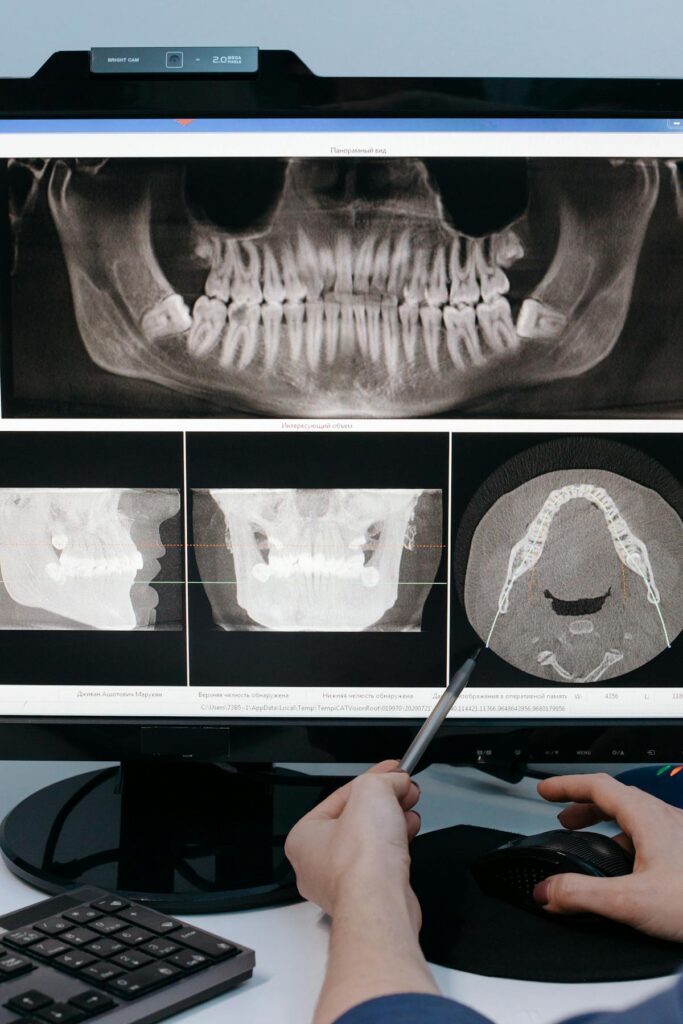
Types of dental X-ray
- Bitewing X-rays. Small images of the back teeth taken while you bite on a tab. They show decay between the teeth and the height of the bone around them.
- Periapical X-rays. Small images that show a whole tooth from the crown to the tip of the root, and the bone around it.
- Panoramic X-ray (OPG). A single wide X-ray of the jaw that shows all the teeth, both jaws and the jaw joints. It is commonly used to assess wisdom teeth.
- Cone beam CT. A three-dimensional scan used for selected cases, such as planning dental implants or complex extractions.
What does a cavity look like on an X-ray?
Tooth decay shows as a darker area in the tooth, because decayed tooth is less dense and lets more X-rays through. Bitewing X-rays are the suitable way to find a cavity between two teeth, where it cannot be seen directly. Very early decay may not show, which is why the X-ray is read together with an examination.
What does a tooth infection look like on an X-ray?
An infection at the end of a root usually shows as a dark area in the bone around the root tip, where bone has been lost. An X-ray also shows how deep a filling or cavity is and how close it sits to the nerve. See signs you may need a root canal.
What does an X-ray of the jaw show?
A panoramic X-ray of the jaw shows the position of wisdom teeth and other unerupted teeth, the level of the jaw bone, cysts and other changes in the bone, and the jaw joints. See wisdom teeth removal.
Are dental X-rays suitable?
Dental X-rays use a very low dose of radiation. Modern digital X-rays use less than older film X-rays, and the beam is limited to the area being examined. The dose from routine dental X-rays is small compared with the background radiation everyone receives from natural sources each year.
Tell us if you are pregnant or might be. Urgent X-rays can still be taken when they are needed, and routine X-rays can usually wait.
How often are dental X-rays needed?
There is no fixed schedule. How often you need X-rays depends on your risk of decay and gum disease, your dental history and what we see at your examination. People with a low risk need them less often than people who have had recent decay.
Dental X-ray FAQs
Do I need X-rays at every check-up?
No. They are taken when there is a clinical reason, and we explain why before taking them.
Can children have dental X-rays?
Yes, when they are needed. They are used to find decay between the back teeth and to check how the adult teeth are developing.
Do dental X-rays hurt?
No. The sensor can feel bulky in the mouth for a few seconds, and that is all.
Check-ups in Penrith
X-rays are taken as part of a dental check-up when they are needed. Contact Penrith Dental Care to book.
This article is general information only and does not replace an assessment with a registered dental practitioner.
Looking for more dental health tips? Browse all articles on the Penrith Dental Care blog, or meet the Penrith Dental Care team. Have a question? See our dental FAQ.
Reviewed by Mina Gibryal, Penrith Dental Care, October 2026. This article is general information and does not replace advice from your own dental practitioner.